Safety in work at height is not merely a regulatory obligation, but a design responsibility that requires specific expertise. Choosing the correct anchor system for industrial or residential roofs means analysing the geometry of the roof surface, the load-bearing structure, and the type of intervention (occasional or frequent maintenance).
In this article we explore the different types of anchor systems and the criteria for selecting the most appropriate solution in compliance with EN 795:2012 — the harmonised European standard recognised across EU and UK markets. We also reference relevant national regulations (such as UNI 11578 for Italy and BS 6698 for the United Kingdom) where applicable, ensuring maximum safety with the 100% Made in Italy quality of SPIDER Linee Vita.
Classification of anchor systems (Types A, B, C, D, E)
According to the normative classification in EN 795:2012 (for devices intended to be removed from the structure), anchor systems are divided into several categories. Below we analyse types, advantages, limitations, and when to prefer each.
Note: This classification applies across EU markets and the United Kingdom, where EN 795 is the reference standard for fall arrest anchor devices. For UK-specific regulatory requirements, refer to BS 6698:2008.
CONTACT US
Type A: single anchor points
These are fixed anchor points, designed to be permanently secured to the structure (timber, concrete, steel).
- What they are: common examples include under-tile hooks or wall-mounted eyebolts.
- When to use them: their use is generally limited to pendulum-effect situations or access routes leading to the main lifeline. They should be avoided where distances to be covered are significant, as moving from one device to the next involves fairly time-consuming procedures, which may discourage the operator from using the system correctly — ultimately resulting in inadequate design in terms of ergonomics and usability.
- Advantages: low cost, minimal visual impact, high robustness.
Type B: removable anchors
These are temporary, removable devices falling within the scope of PPE (EU Regulation 2016/425). Specifically, within EN 795:2012, the CE marking applies to Type B devices (and, as we will see, also to Type E), as these are the ones harmonised with the PPE Regulation.
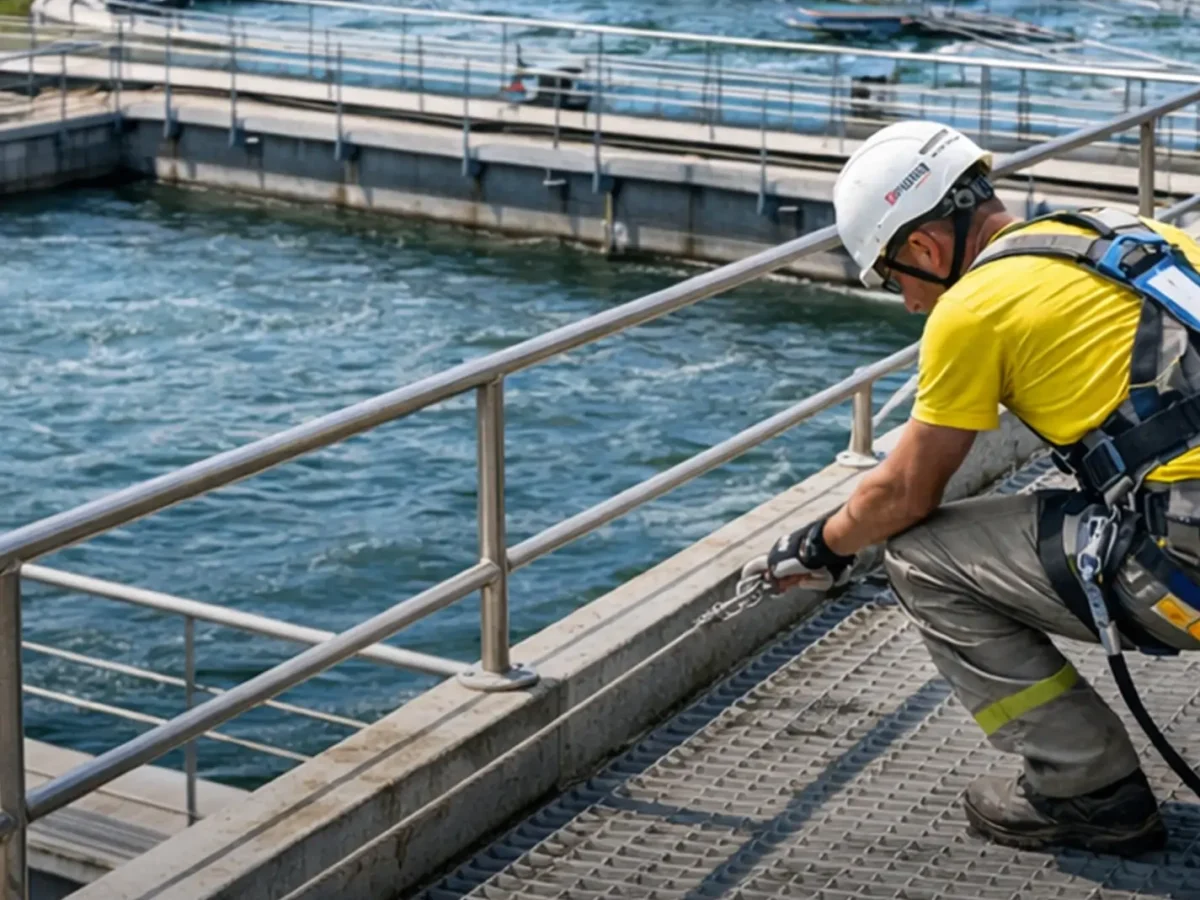
- What they are: tripods, beam clamps, slings, temporary mobile lifelines.
- When to use them: emergency interventions or maintenance work in the absence of permanent systems.
- Limitations: they require assembly and disassembly at every use; the operator must be specifically trained in their correct positioning.
Type C: flexible lifeline anchors
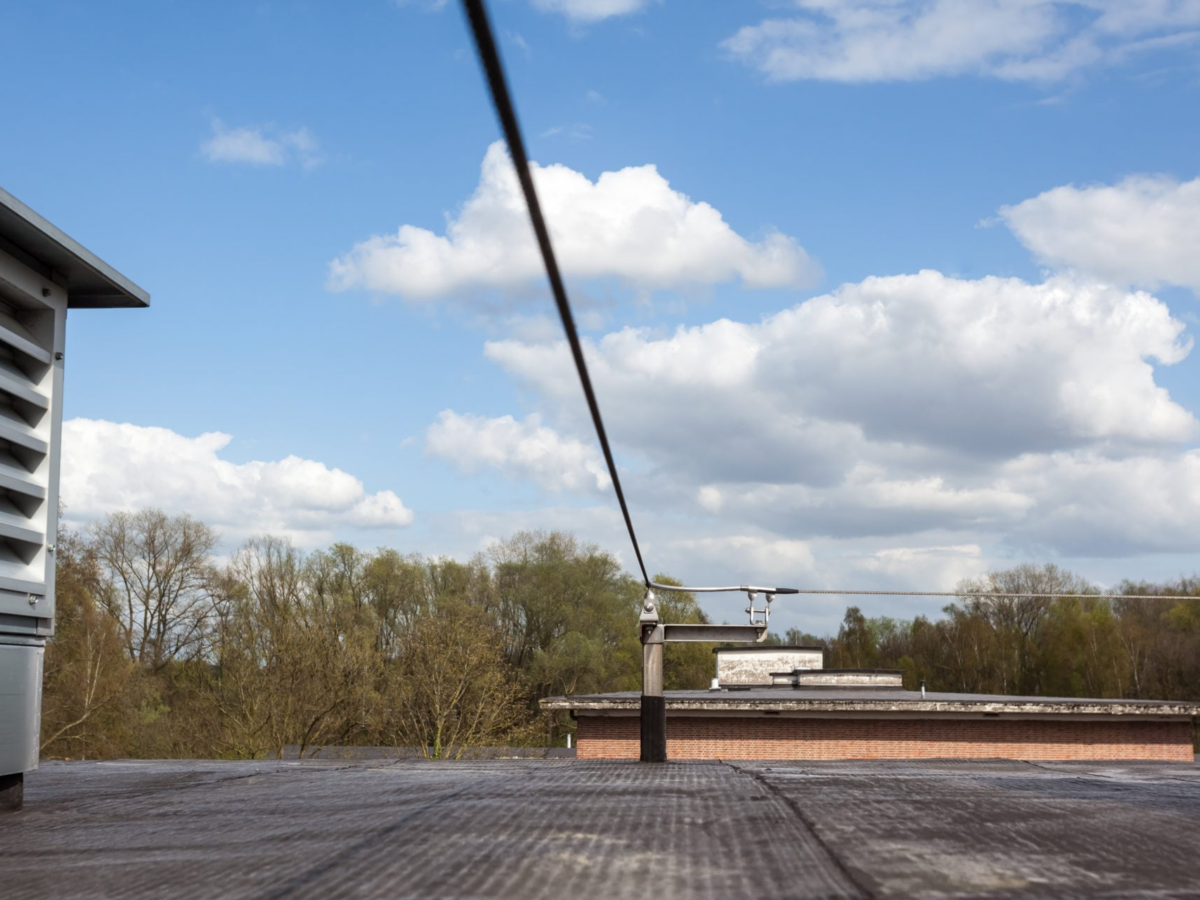
These are true lifeline systems consisting of two or more supports and a flexible cable, generally steel wire rope, to which the operator can connect using their personal protective equipment (PPE).
- When to use them: extended roof surfaces, situations requiring continuous movement without detachment (e.g. ridge lines, industrial walkways).
- Advantages: greater ergonomics compared to single anchor points, as the operator can cover long distances without ever disconnecting from the device.
- Limitations: the clearance space available beneath the line is sometimes insufficient to guarantee operator safety due to the so-called free-fall distance.
- Note: they require more careful calculation of the “free-fall distance” (clearance below the anchor) due to cable deflection under load.
Type D: rigid rail anchor systems
To address the issue of deflection, Type D devices come into play, lifeline systems that replace the flexible cable with a rigid guide, generally a rail, along which a trolley slides to serve as a mobile anchor point. Being rigid and having minimal deflection, these devices allow the required free-fall distance to be reduced to levels comparable with Type A systems, while still offering good ergonomic performance, as the operator can cover long distances without ever disconnecting from the device.
- When to use them: industrial environments, ceilings, or wherever free-fall clearance is very limited.
- Advantages: no sag (deflection) in the event of a fall, excellent gliding performance.
- Limitations: higher cost and greater visual impact compared to cable systems.
Type E: deadweight (ballasted) anchors
Systems that rely on weight (mass) and friction to arrest a fall, without penetrating the roof surface.
- When to use them: flat roofs with waterproof membranes that cannot be punctured, paved terraces.
- Limitations: suitable only for surfaces with a maximum slope of 5°.
Not sure which solution is right for your roof? Every roof surface has its own structural and regulatory challenges. Don’t risk non-compliant installations: request a preliminary technical assessment from the SPIDER Linee Vita specialists.
CONTACT US
Reference standards: EN 795, BS 6698, and CE/UKCA marking
To navigate the different types of anchor systems, it is essential to distinguish between the standards governing permanent devices and those governing temporary ones. This distinction has a direct bearing on CE or UKCA marking and on the scope of application (residential or industrial).
For EU markets (including Italy), the primary reference is EN 795:2012, which covers devices intended to be removed from the structure. For the United Kingdom, BS 6698:2008 provides the equivalent regulatory framework, with functional requirements that align with EN 795 but use different classification criteria.
Before addressing CE marking, it is important to differentiate between permanent devices (construction products, designed for long-term installation) and temporary removable devices (PPE or anchorage equipment, designed for single or limited use).
N 795:2012 classification and CE marking:
Under EN 795:2012, CE marking applies only to Types B and E — these are the device types harmonised with the PPE Regulation (EU 2016/425). Types A, C, and D conform to EN 795 but are not harmonised and therefore fall outside the scope of CE marking; they must still comply with the standard but do not carry CE marking under the PPE framework.
BS 6698:2008 classification (UK):
BS 6698:2008 uses a different classification system from EN 795 (based on Class and Group rather than Type A-E). When selecting or specifying fall arrest anchor systems for UK applications, compliance with BS 6698:2008 takes precedence. UKCA marking (post-Brexit equivalent to CE marking) applies to devices classified as PPE under UK regulations, but the classification criteria differ from EN 795.
Residential roofs (residential and apartment buildings)
In the residential sector, installations are almost always intended to remain in place permanently for future maintenance work.
EU / Italy:
- Standard: EN 795:2012 for permanent anchor devices; for Italy specifically, UNI 11578:2015 provides additional requirements for multi-user permanent installations.
- CE marking: Under EN 795:2012, CE marking applies only to Type B and Type E devices (partially harmonised with PPE Regulation 2016/425). Type A, C and D devices conform to EN 795 but fall outside the scope of CE marking.
- Multi-user: UNI 11578:2015 is natively designed for simultaneous use by multiple operators; compliance is required for Italian residential installations.
United Kingdom:
- Standard: BS 6698:2008 for fall protection systems on buildings.
- UKCA marking: Applies to devices classified as PPE under UK regulations (post-Brexit equivalent to CE marking). Classification criteria differ from EN 795 Type A-E system.
- Multi-user: BS 6698:2008 accommodates multi-user scenarios; verify compliance with UK Building Regulations and HSE guidance.
Industrial roofs
Requirements vary: fixed lifelines or temporary anchor points may be needed depending on the specific work being carried out.
EU / Europe:
- Standards: EN 795:2012 for devices intended to be removed from the structure (temporary/removable); UNI 11578:2015 (Italy) for permanent installations. For multi-user temporary systems, CEN/TS 16415:2013 supplements EN 795 with additional testing and certification requirements.
- CE marking: EN 795:2012 applies to removable devices; CE marking covers Type B and E only. Type A, C and D conform to the standard but are not CE-marked under PPE framework.
- Multi-user: Possible on EN 795 systems only if certified to CEN/TS 16415:2013; UNI 11578 (Italy) is natively designed for multi-user permanent systems.
United Kingdom:
- Standards: BS 6698:2008 for fall protection systems; for temporary/specialist equipment, refer to HSE guidance and relevant equipment-specific standards.
- UKCA marking: Applies to PPE classified under UK regulations. UK industrial installations may require additional assessment under Work at Height Regulations 2005.
- Multi-user: Multi-user capability must be verified for the specific system and work scenario; HSE inspection and certification may be required depending on risk classification.
How to choose the right anchor system: key decision factors
Choosing between a single anchor point, a lifeline, or a rail system depends on a thorough risk assessment. Here are the key factors that guide SPIDER Linee Vita’s design approach:
1. Roof structure
- Material and load capacity: a timber roof requires different fixings than reinforced concrete or trapezoidal steel sheeting. Structural verification is always the first step.
- Geometry and pitch: complex or steeply pitched roofs may require a combination of lifelines (Type C) and single anchor points (Type A) to prevent the pendulum effect at corners.
2. Type and frequency of work
- Infrequent access: for annual antenna maintenance, a well-positioned set of anchor hooks (Type A) may be sufficient and cost-effective.
- Frequent access: for cleaning photovoltaic panels or industrial skylights, a lifeline (Type C) or rail system (Type D) provides greater ergonomics and operational efficiency.
3. Fall restraint vs. fall arrest
- Restraint systems: designed to prevent the operator from reaching the fall edge — the preferred approach wherever possible.
- Fall arrest systems: stop the operator after a fall has begun. They require precise calculation of the free clearance below to prevent ground impact.
Why choose SPIDER Linee Vita: safety close to home
At SPIDER Linee Vita, we don’t simply supply products, we offer a complete safety ecosystem of installation and maintenance of lifeline systems. The breadth of our range allows us to cover every need, from residential rooftops to large industrial facilities.
Here is what sets us apart:
- Short supply chain and Made in Italy: our components are manufactured 100% in Italy, by certified suppliers within a 15 km radius of our headquarters. This guarantees absolute quality control and fast response times.
- Robust materials: we use stainless steel and weather-resistant aluminium alloys, ensuring durability even in demanding environments.
- Integrated approach: from risk assessment and design through to installation and certification.
- Training: through the Scuola Italiana Anticaduta (Italian Fall Protection School), we train operators in the correct use of PPE and installed systems — because even the best anchor point is useless if used incorrectly.
Secure your work at height
Do you need to design an anchor system or bring an existing roof up to standard? Trust the certified quality and short supply chain of SPIDER®. From design to installation, we handle everything.
CONTACT US FOR A FREE QUOTE