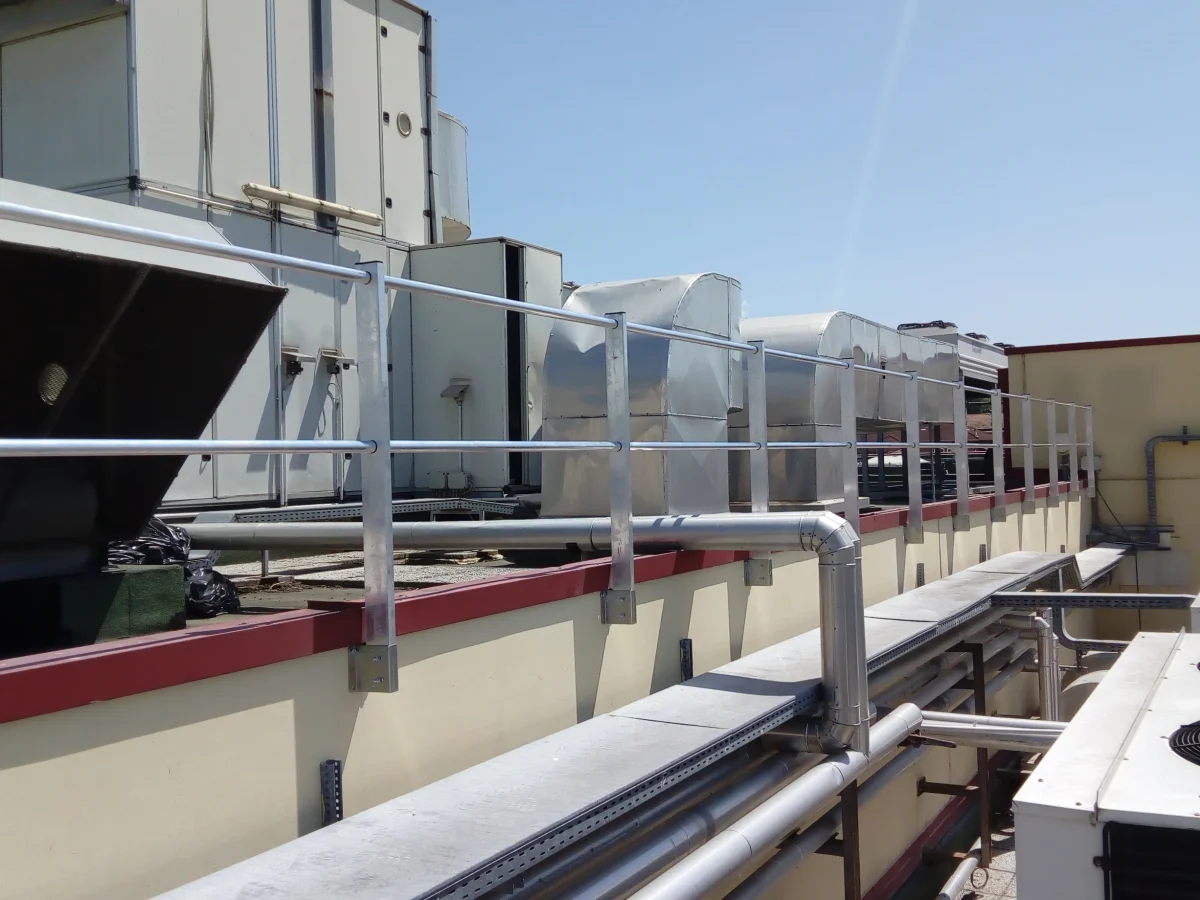
Over the past few years, roofs have evolved into permanent workspaces, hosting photovoltaic systems, HVAC units, antennas and data backbones. The presence of workers at height for scheduled maintenance activities is no longer an exception but has become standard practice. This evolution has made the use of permanent fall protection guardrails as collective protection systems increasingly necessary.
Until now, however, the design of permanent guardrails has been carried out within a fragmented regulatory framework, relying on provisions intended for temporary systems, standards related to machinery access, and, in the background, the NTC 2018, with higher load requirements.
With UNI 11996:2025 “Permanent fall protection guardrails – Safety requirements, test methods and conditions of use”, this regulatory gap is addressed and the framework is reorganised into a more coherent and dedicated standard.
Before the introduction of UNI 11996, the main references used for roof guardrails were essentially three:
UNI EN 13374:2013: the standard for temporary edge protection systems, intended for construction sites and ongoing works. It defines system classes, dimensional, geometric and performance requirements, static and dynamic load values, and test methods. However, its scope is explicitly limited to temporary systems.
UNI EN ISO 14122-3:2016: part of the series covering permanent means of access to machinery. It provides requirements for stairs, walkways and guardrails that form part of the machine or of structures whose primary purpose is access to the machinery itself.
NTC 2018: the reference legislation for structural design, defining vertical loads (uniformly distributed and concentrated) and horizontal linear loads, which are more severe than those specified in EN 13374 and differentiated according to the intended use of the system.
For HSE managers, safety officers and designers, this meant having to combine different references: one standard for temporary systems, one for machinery access and one for the building structure. The associated risk was either under-dimensioning permanent guardrails with respect to the loads required by the NTC, or misapplying requirements intended for different contexts.
This is precisely where UNI 11996:2025 comes into play: it retains the conceptual framework of UNI EN 13374, but reinterprets it to address the needs of permanent fall protection guardrails on roofs or civil structures, aligning vertical and horizontal load requirements with current technical legislation and introducing specific provisions on durability, fixing methods, maintenance and rescue operations.
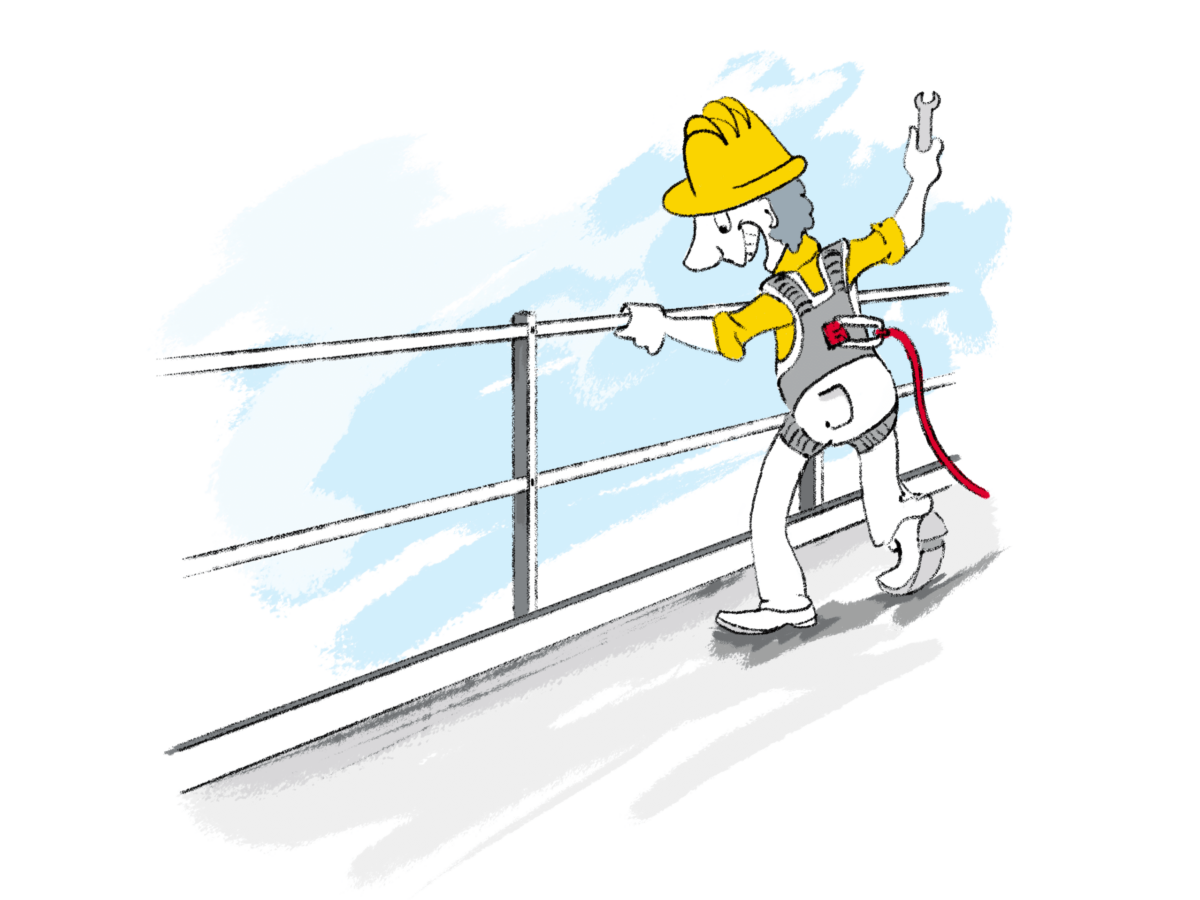
UNI 11996 applies to permanent fall protection guardrails used as collective protection systems on buildings, infrastructures, civil works, structures and industrial installations, in all situations where a risk of falling from height exists.
The standard explicitly refers to its applicability to Category H roofs and to walkable roofs classified within use environments A, B1, B2 and C1.
The following are excluded:
The standard defines a permanent fall protection guardrail as an assembly of components intended to protect people from falling to a lower level and to retain materials. It is a collective protection system that includes at least:
Two classes of guardrails are identified:
Class A – designed to resist static loads only and required to:
Class B – designed to resist both static loads and moderate dynamic actions, typical of pitched roofs or situations involving sliding along the roof slope.
The design and designation of products shall always indicate the applicable class, as this directly affects the selection of the system according to roof geometry and access conditions.
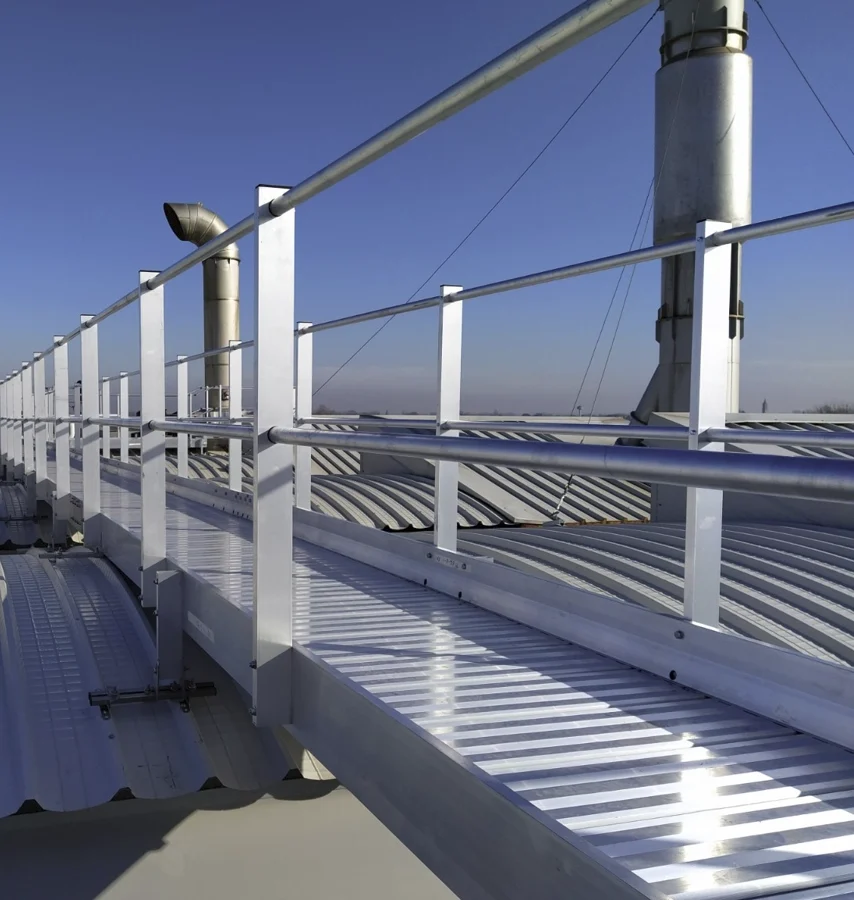
The most critical, and at the same time most anticipated, aspect concerns the design loads.
For both classes, UNI 11996 refers to the static and dynamic load cases of UNI EN 13374, but introduces a substantial modification to the horizontal load values acting on the top rail:
This approach eliminates the discrepancy between a less demanding product standard and structural regulations: a permanent fall protection guardrail can no longer be designed with horizontal loads different from those required for building guardrails.
The standard further specifies that the 1.0 kN/m applies only to the top rail; for the mid-rail, the load values defined in UNI EN 13374 (0.3 kN) remain applicable.
The allowable elastic deflection at the serviceability limit state is increased to 150 mm, compared to the 55 mm specified in EN 13374, acknowledging the different conditions of use and the overall structural behaviour of the system.
For Class B, the dynamic load requirements of EN 13374 remain mandatory, with specific test cases for pitched roofs.
UNI 11996 establishes a systematic framework for verification, defining the following procedures:
visual inspection of the guardrail’s structural integrity;
measurement of key parameters (heights, safety distances, resistance);
structural calculations in accordance with UNI EN 13374 for Classes A and B, using the new load values;
laboratory testing, also carried out in accordance with EN 13374.
Calculations and testing are considered alternative approaches: the adoption of either method alone is sufficient to demonstrate compliance with the requirements.
With regard to durability, guardrails shall:
provide corrosion protection at least compliant with corrosivity category C3 according to UNI EN ISO 9223;
for painted steel, ensure a protective system durability classified as “high (H) – 15 to 25 years” in accordance with UNI EN ISO 12944;
comply with the specific provisions applicable to stainless steel, aluminium, hot-dip galvanised steel and organic coatings, by reference to the relevant structural and protective standards.
In addition, the standard requires the absence of water stagnation within the components and that the system does not interfere with the waterproofing performance of the roof or of the underlying structures.
UNI 11996:2025 introduces a structured system of inspections, maintenance, repairs and records, aimed at ensuring the long-term preservation of the declared performance levels.
The standard defines four types of inspection:
pre-installation inspection;
in-use inspection, to be carried out before each access;
periodic inspection, at intervals not exceeding 48 months;
extraordinary inspection, required when the guardrail shows defects or has been subjected to the effects of a person’s fall.
All activities shall be recorded in a dedicated inspection and maintenance log, clearly indicating inspection dates, responsible persons, outcomes and corrective actions performed.
Two annexes of UNI 11996 deserve particular attention from professionals operating on construction sites:
Annex B – Determination of fixings (informative)
The manufacturer shall specify in the manual the design loads required to determine the fixings and to verify the suitability of the supporting structure. The actual assessment is entrusted to a qualified technician, who shall consider the actual materials, build-up layers and site conditions.
The standard provides a reference grid for timber, steel and concrete, associated respectively with screws, bolts and mechanical or chemical anchors, while leaving it to the technician to extend the verification to other materials (e.g. masonry, stone) through calculations or on-site tests.
Annex C – Rescue (normative)
Where, during the installation or dismantling of the guardrail, the installer uses a personal fall protection system, the manufacturer shall indicate in the manual the need for a rescue procedure in the event that the operator is in a condition of inert suspension.
The supporting structure shall also be verified for the additional loads resulting from rescue operations.
For HSE managers, safety officers and safety coordinators, this means that a guardrail design cannot be considered complete without a verification of the fixings and a rescue plan for emergency situations during installation.
From an organisational and corporate perspective, UNI 11996:2025 introduces several tangible implications:
For site technicians and safety consultants, the framework is significantly simplified: where it was previously necessary to combine UNI EN 13374, UNI EN ISO 14122-3 and NTC, a dedicated standard is now available that integrates these references and streamlines both the selection and verification of permanent fall protection guardrails.