Working in a confined space means operating in an environment where any unexpected event can become critical within seconds. Toxic gases, oxygen deficiency, restricted access: in these settings, recovering an incapacitated worker is the most demanding phase of the entire operation, and a confined space rescue device must be selected with technical precision — not based on price or immediate availability.
Legislative Decree 81/2008 and DPR 177/2011 require risk assessment, the preparation of operational and emergency procedures, and the use of PPE, equipment, and trained personnel appropriate to the specific task. For work in potentially contaminated environments, Article 66 of Legislative Decree 81/2008 further requires continuous supervision during operations and the ability to readily recover an unconscious worker. This guide examines how the main systems work, which regulations govern their compliance, and — most importantly — how to make the right selection based on the type of access.
What is a confined space?
Under the scope of DPR 177/2011 and the technical criteria of UNI 11958:2024, a confined and/or potentially contaminated space is defined as an enclosed area not designed for the continuous presence of workers, characterized by limited or difficult access, potentially unfavorable ventilation, and the presence — or possible development — of hazardous conditions for health and safety (oxygen-deficient or oxygen-enriched atmospheres, toxic gases, flammable or explosive vapors).
This definition includes, by way of example: silos and tanks, cisterns, underground basins, wells, ducts, tunnels, wastewater treatment plants, sewer lines, and inspection chambers. It is not the size of the space that makes it confined: it is the combination of restricted access and potential atmospheric or rescue hazards.
What makes these environments dangerous beyond air quality is the inability to self-evacuate in the event of sudden illness or emergency. This is why rescue cannot be something organized on the spot: it must be planned, equipped, and in place before entry.
Not sure which length is right for your scenario? Describe the characteristics of the environment: the Spider Linee Vita technical team will identify the correct device for you.
CONTACT USOur confined space rescue devices
For vertical access operations in confined spaces, Spider Linee Vita offers three retractable devices with integrated rescue winch, compliant with EN 360:2002 and EN 1496:2017 Class B, with ATEX marking in accordance with Directive 2014/34/EU, within the category and zone limits specified by the manufacturer. Designed for vertical use, tested up to a maximum load of 140 kg.
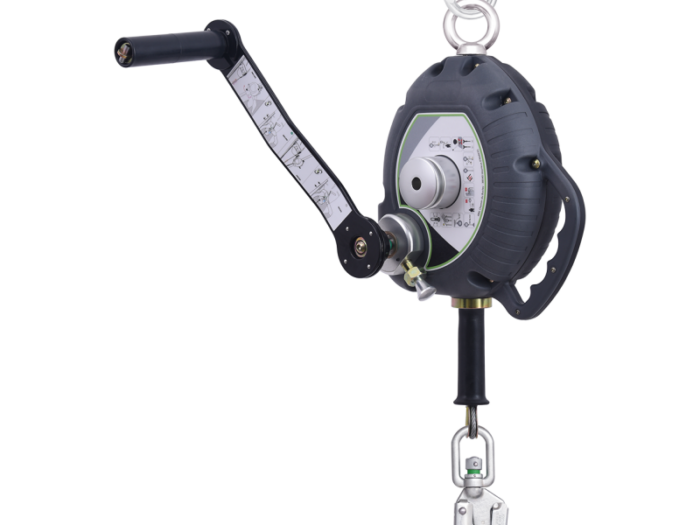
Brand: Kratos | Cable length: 10 m | Weight: 7.40 kg
Retractable fall arrester with integrated rescue winch. Galvanized steel cable Ø 4.5 mm with cable grip handle. Braking system with impact force < 6 kN. High-strength polymer housing with ergonomic carrying handle. Swivel snap hook for connection to the anchor point. Strength > 12 kN.
Compliance: EN 360:2002 · EN 1496:2017 class B · ATEX Directive 2014/34/EU
€ 923.88
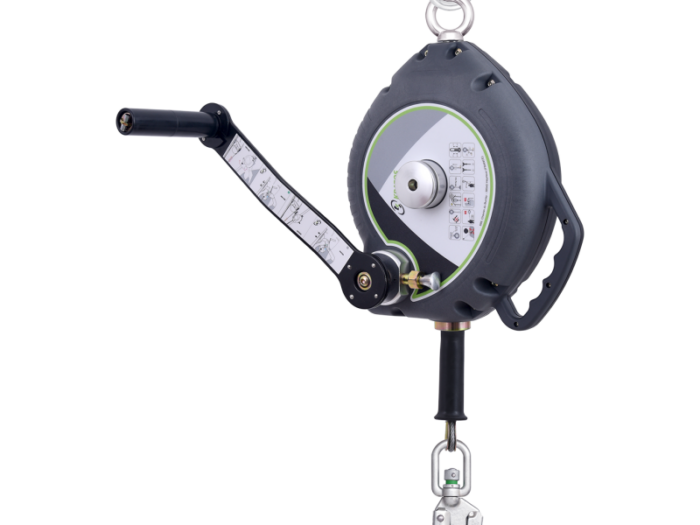
Brand: Kratos | Cable length: 10 m | Weight: 7.40 kg
Retractable fall arrester with integrated rescue winch. Galvanized steel cable Ø 4.5 mm with cable grip handle. Braking system with impact force < 6 kN. High-strength polymer housing with ergonomic carrying handle. Swivel snap hook for connection to the anchor point. Strength > 12 kN.
Compliance: EN 360:2002 · EN 1496:2017 class B · ATEX Directive 2014/34/EU
€ 923.88
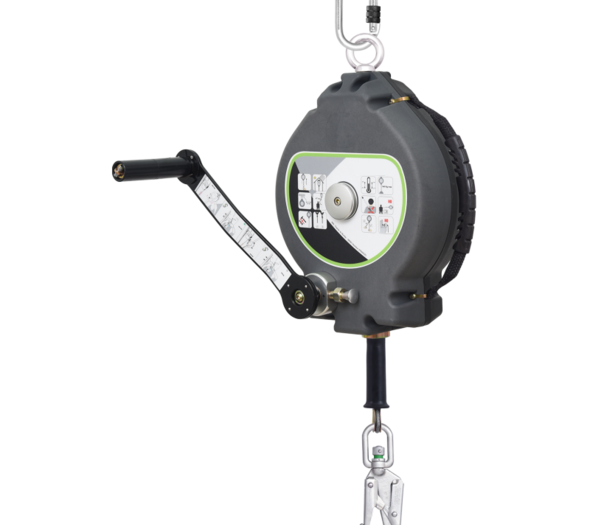
Brand: Kratos | Cable length: 30 m | Weight: 14.80 kg
The 30 m version is designed for access points requiring greater depths, while maintaining the same construction and safety features as the series: integrated braking system, galvanized steel cable, manual emergency recovery. Maximum load: 140 kg. Strength > 12 kN.
Compliance: EN 360:2002 · EN 1496:2017 class B · ATEX Directive 2014/34/EU
€ 1,710.60
Not sure which length is right for your scenario? Describe the characteristics of the environment: the Spider Linee Vita technical team will identify the correct device for you.
Here is the translation:
Regulatory framework for confined space rescue
Selecting a rescue device cannot be separated from a thorough understanding of the regulatory framework. This is not a formality: it is the prerequisite for choosing genuinely suitable PPE and for avoiding liability.
Legislative Decree 81/2008 requires employers to assess the specific risks of confined spaces and to provide workers with adequate PPE, including rescue and recovery systems. DPR 177/2011 specifically governs work in confined and potentially contaminated environments: it establishes qualification and training obligations, operational procedures, and the mandatory presence of at least one external supervisor for every operation.
At the technical level, two standards regulate these devices:
EN 360:2024 covers retractable fall arresters — devices that automatically arrest a fall when the operator loses footing. They provide protection during the work phase but are not designed for active rescue.
EN 1496:2017 covers rescue lifting devices, specifically designed to recover an incapacitated worker. Class A is intended for lifting only; Class B also allows a limited lowering function, under the conditions specified by the standard and the manufacturer. A device that complies with both EN 360 and EN 1496 Class B combines fall arrest protection and rescue capability in a single unit: this is the most efficient solution for vertical access with a stable working platform.
How to select the right device based on access type
The type of access is the determining factor in device selection. Here are the three main scenarios.
Access via stable footing (fixed ladders, fixed steps)
If the worker enters the confined space independently — descending a fixed ladder or steps — and reaches a stable platform inside, the correct system is a retractable device with emergency rescue function (EN 360 + EN 1496). The worker can move freely during operations, protected by the fall arrest system; in the event of sudden illness or emergency, the external supervisor activates the integrated winch without having to enter the confined space.
In this scenario, the device must be positioned above the access opening — using an arm or davit if the structure does not allow direct anchoring — to ensure the cable operates vertically relative to the worker.
Suspension access (vertical lowering)
If the worker must be lowered in suspension to reach the work area, a retractable device with integrated rescue function is not sufficient: its recovery mechanism is not designed for repeated lifting and lowering. The correct configuration requires an EN 360 retractable device combined with a separate EN 1496 winch.
The operational configuration must be defined based on the manufacturer’s instructions and the risk assessment. Where access involves lowering or raising the worker, a system specifically suited to the movement of persons must be used — either separate or integrated as permitted by the manufacturer — and always combined with an independent fall arrest system. The retractable device with rescue function must not be used as a standard means of descent or ascent unless the manufacturer has explicitly declared it suitable for that purpose. In an emergency, the external supervisor can activate the rescue function provided by the system without entering the confined space.
Horizontal or angled access
For horizontal ducts, inclined conduits, or lateral access points, the configuration is more complex: a vertical retractable device does not function effectively when the worker moves on a horizontal plane. These scenarios require a specific analysis of the geometric characteristics of the environment and the residual risks.
Contact the Spider Linee Vita technical team for a personalized assessment of your scenario.
CONTACT USMaintenance and periodic inspection of rescue devices
Purchasing a certified device is only the first step. Regulatory compliance must be maintained over time through proper PPE management.
EU Regulation 2016/425 governs PPE and, for Category III PPE, the CE marking is followed by the number of the notified body involved in production surveillance. Fall arrest PPE is normally classified as Category III, with an EU declaration of conformity and manufacturer’s instructions. The inspection interval must comply with the manufacturer’s requirements and UNI EN 365; for most fall arrest PPE and rescue devices, the standard interval is at least annual, unless conditions of use are particularly demanding or the manufacturer specifies more restrictive intervals.
One rule that is frequently underestimated: after every activation of the rescue function in an emergency, the device must be withdrawn from service, inspected, and if necessary overhauled before being returned to use. An activation of the braking system or the rescue mechanism may have stressed internal components that are not visible from the outside. Returning an uninspected device to service after an emergency is both a regulatory violation and a genuine safety risk.
Every Category III PPE item must be identified by serial number and associated with a use and maintenance log that records every inspection, every intervention, and every activation event.
Discover the Spider Linee Vita PPE inspection and maintenance service.