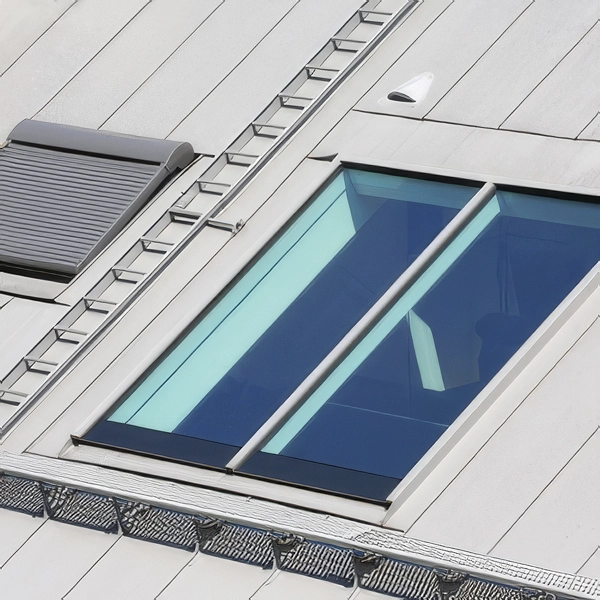
Within the various regional regulations governing permanent anchorage systems on roofs, there is a clear requirement not only for the installation of lifelines and fall protection systems, but also for the provision of roof access points with specific technical characteristics.
In this regard, many regulations specify the minimum dimensions of skylights, defining a minimum clear opening area and, in the case of rectangular skylights, imposing minimum dimensions for each individual side.
These minimum requirements are established in consideration of emergency rescue operations. Although skylights could theoretically be smaller to allow the passage of a single person, they are intentionally oversized to permit the passage of a stretcher or other rescue equipment.
As a result, the dimensional requirements often lead to the exclusion of skylight use as an access point when the prescribed criteria are not met, in favour of temporary access systems such as mobile towers, scaffolding, or portable leaning ladders.
Designers are therefore required to decide whether to allow a deviation permitting skylight access or to define an alternative access method. This decision is far from straightforward when considering the different risk profiles associated with each solution.
Access to the roof by means of a portable leaning ladder, if not supplemented by additional protective measures, may in some cases be more hazardous than remaining on the roof itself, and even more hazardous than accessing the roof through a skylight whose dimensions are smaller than those prescribed by regulations.
What choice should the designer therefore make when it is not possible to install a large skylight? Using a skylight that is sufficient for the passage of a person may appear to be the most straightforward solution, even when it does not comply with the required dimensions. However, this approach does not fully align with the provisions of many regional regulations.
Why, then, are adequately sized skylights not always installed?
The answer lies in building design practices and in the late involvement of fall protection system designers compared to structural designers. In the construction of timber roofs, for example, the spacing between joists typically ranges from 50 cm to 75 cm. With such spacing, achieving a minimum clear side dimension of 70 cm (as required by some standards) is difficult or even impossible without affecting the roof structure.
In existing buildings, installing a skylight of compliant dimensions would often require a structural intervention, resulting in increased costs and administrative procedures.
Example of compliant skylight dimensions
Decree No. 119 of 14/01/2009 – Minimum requirements: