Fall arrest PPE is of fundamental importance for all professional categories and specialists who carry out work at height. Below you will find an overview of the main types of fall protection PPE, their purpose and when their use is required.
Who must use fall protection PPE?
The use of PPE for work at height is required for all individuals who operate at specific heights where there is a risk of falling from height. According to current Italian legislation, the use of fall arrest PPE becomes mandatory when activities are carried out at a height of 2 metres or more above a stable working surface.
Therefore, the following activities are considered work at height and require training and the use of appropriate equipment:
These are just some examples of the many professional categories involved in work at height.
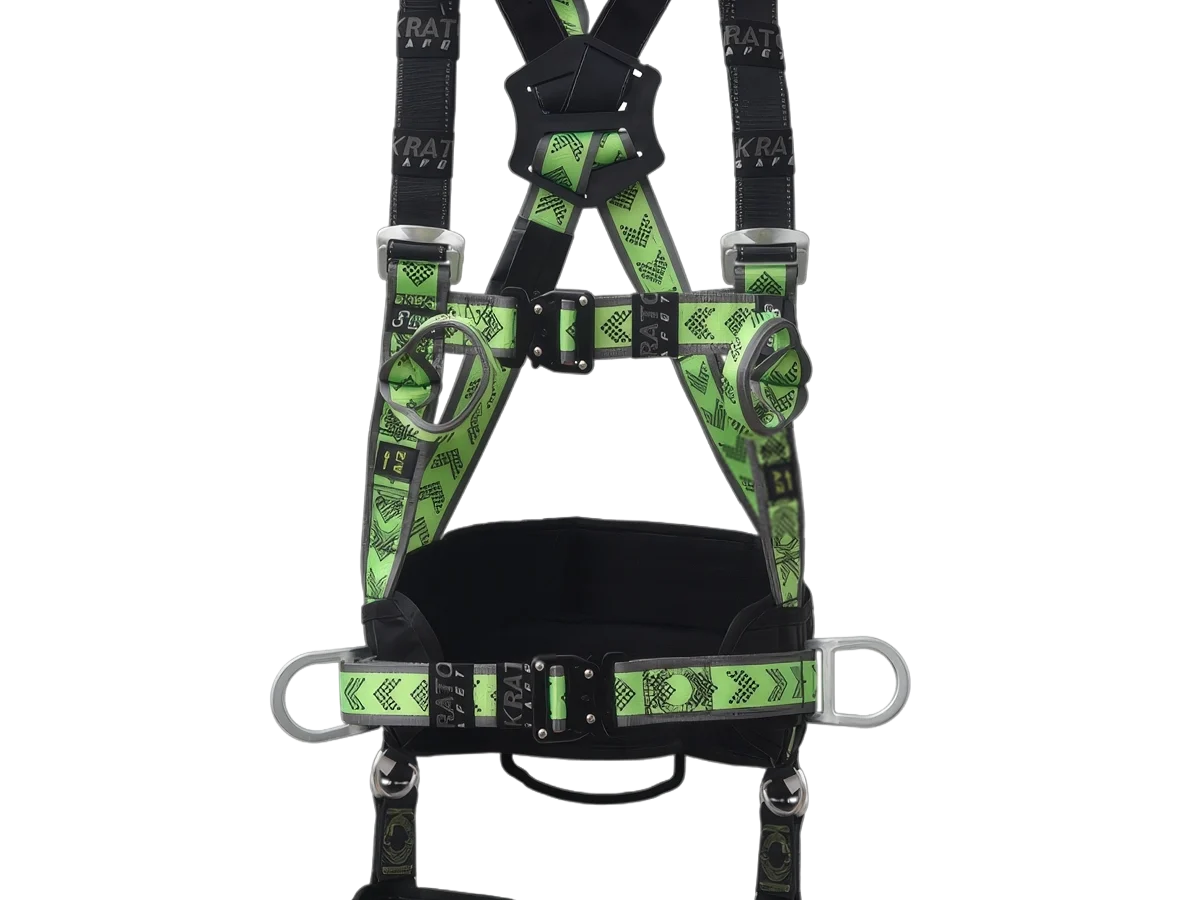
Contact usSafety harnesses are Category III personal protective equipment of great importance in many work-at-height activities. The harness represents the starting point of fall protection, as it is the PPE specifically designed to arrest the worker in the event of an accidental fall.
From a regulatory perspective, harnesses fall under three European technical standards:
EN 361 for harnesses designed to withstand and distribute fall arrest forces;
EN 358 for work positioning systems;
EN 813 for sit harnesses with leg loops.
These standards define the minimum requirements in terms of ergonomics and strength. Harnesses are mainly distinguished by the number and position of attachment points:
2 attachment points: The most common harnesses for work at height; they are lightweight and equipped with one dorsal and one sternal attachment point;
4 attachment points: In addition to the two above, these harnesses include two lateral attachment points designed for work positioning (not for fall arrest). They comply with EN 361 and with one or both of EN 358 and EN 813;
5 attachment points: In addition to the previous points, a fifth frontal attachment point at waist level is provided, intended for rope access and rope-based work activities.
In addition, there are harnesses specifically designed for use in confined spaces, which, besides the standard attachment points, are equipped with shoulder lifting straps to facilitate rescue and recovery operations.
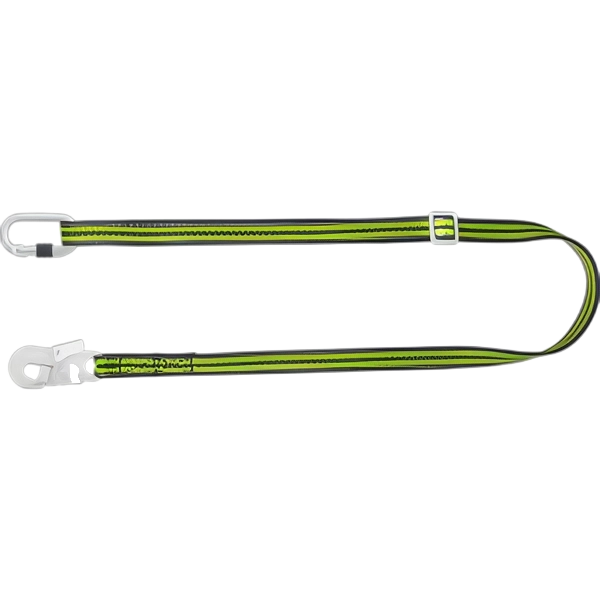
Fall arrest lanyards are personal safety devices that, during work at height, are used in combination with harnesses and anchorage systems. These PPE mainly perform two functions: work positioning and fall arrest.
Lanyards are considered work positioning lanyards when they are used solely to maintain the worker’s position. Conversely, lanyards are classified as fall arrest lanyards when they are used as part of a fall arrest system and are therefore capable of absorbing the energy generated during a fall.
There are several types of lanyards, which can be grouped into three main categories:
Single lanyard
Double lanyard
Adjustable lanyard
The construction of these PPE is relatively simple and consists of the following components:
a central line, available in various materials (synthetic fibre rope, webbing, chain, steel wire rope);
a starting connector;
an end connector.
There are specific work activities where it is not possible to install fixed anchorage points. In such cases, the use of removable fall protection systems becomes necessary.
Removable fall protection systems are therefore PPE for work at height designed to address hazardous situations caused by the absence of fixed anchorage points. Several types of removable PPE are available, including:
Tripods for access to confined spaces;
Counterweighted support bases;
Fall protection davit arms;
Support bases with clamp-mounted fall arrest devices;
Rescue brackets and recovery systems.
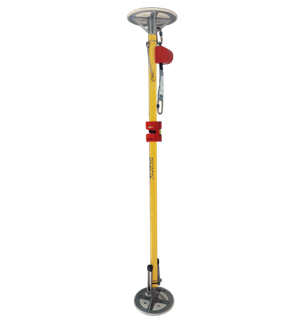
Spider has developed an innovative system called SUN200, specifically designed for installers of awnings, windows and doors, industrial doors, and air-conditioning units.