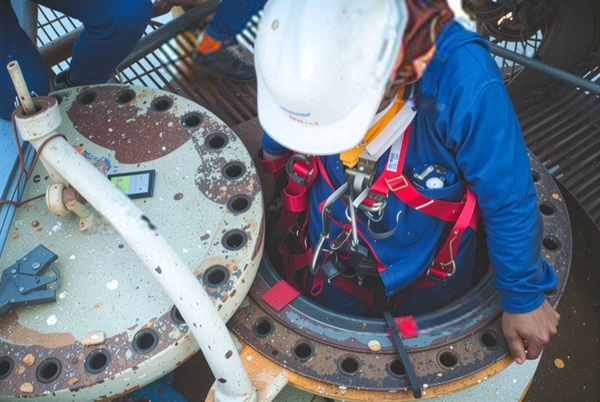
When we talk about confined spaces, we refer to work environments that must never be underestimated, as they present a very high risk of fatal accidents or serious injuries due to the presence of hazardous substances or dangerous conditions.
Let us first clarify what confined spaces actually are. Many people, by simple association, would say that a confined space is a closed or enclosed area. However, this is not entirely accurate. You may be surprised to learn that a confined space is not necessarily fully enclosed. For instance, a tunnel can be considered either a confined or an open space depending on specific conditions. Sounds confusing? That is perfectly normal, especially for those with limited experience in this field.
In summary, a confined space is an environment with limited entry and exit openings, large enough to be entered at least partially (for maintenance or similar activities), not designed for continuous human occupancy, with inadequate natural ventilation, or where highly or lethally toxic gases or liquids may be present.
Practical examples include: tanks, silos, reactor vessels, closed drainage systems, sewer networks.
More difficult to identify are: open cisterns, basins, combustion chambers inside furnaces, pipelines, and environments with insufficient or no ventilation (such as tunnels).
At this point, the concept should be clearer. However, this is not the end of the matter. Simply identifying the environment and raising awareness is not sufficient to safely commence work activities.
Why?
On a vessel in the port of Porto Marghera, two workers engaged in tank cleaning operations died of asphyxiation due to high CO₂ concentration. In the same year, in Molfetta (BA), five people lost their lives as a result of sulphur fumes released during the cleaning of a storage tank. In Pavia (2019), four workers died after drowning in a waste collection tank for organic residues from an adjacent cattle farm, having been overcome by carbon dioxide.
So what does this mean?
We must be fully aware of how to operate safely in every circumstance, through continuous training on the regulatory framework governing workplace safety. Initially, the main reference legislation was Legislative Decree 81/08 (Articles 66 and 121 and Annex IV, point 3). Subsequently, Presidential Decree 177/2011 was introduced (“Regulation laying down requirements for the qualification of companies and self-employed workers operating in potentially contaminated or confined spaces”).
This regulation defines the requirements that companies must meet in order to operate in potentially contaminated or confined spaces, namely that:
Information and training activities are provided to all personnel (training courses for confined spaces are therefore mandatory, even though the State-Regions Conference has not yet defined a specific duration or mandatory refresher intervals, which are nonetheless strongly recommended);
Practical training and drills are carried out for all personnel involved in activities within confined or potentially contaminated spaces;
Appropriate personal protective equipment (PPE), instruments and work equipment suitable for preventing the specific risks are supplied;
full compliance is ensured with all provisions concerning risk assessment, health surveillance and emergency management measures;
personnel are employed such that at least 30% of the workforce has a minimum of three years’ experience in activities carried out in potentially contaminated or confined spaces;
applicable requirements relating to the Single Document of Contribution Regularity (DURC) are respected.