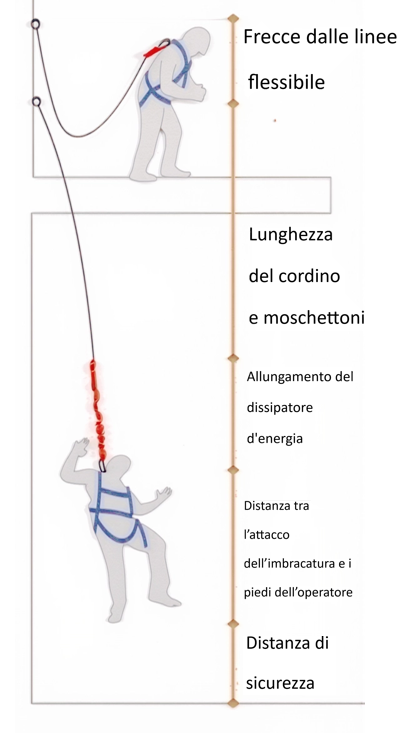
The clear fall distance (clearance) corresponds to the safety space below the worker required to safely arrest a potential fall without impact against obstacles.
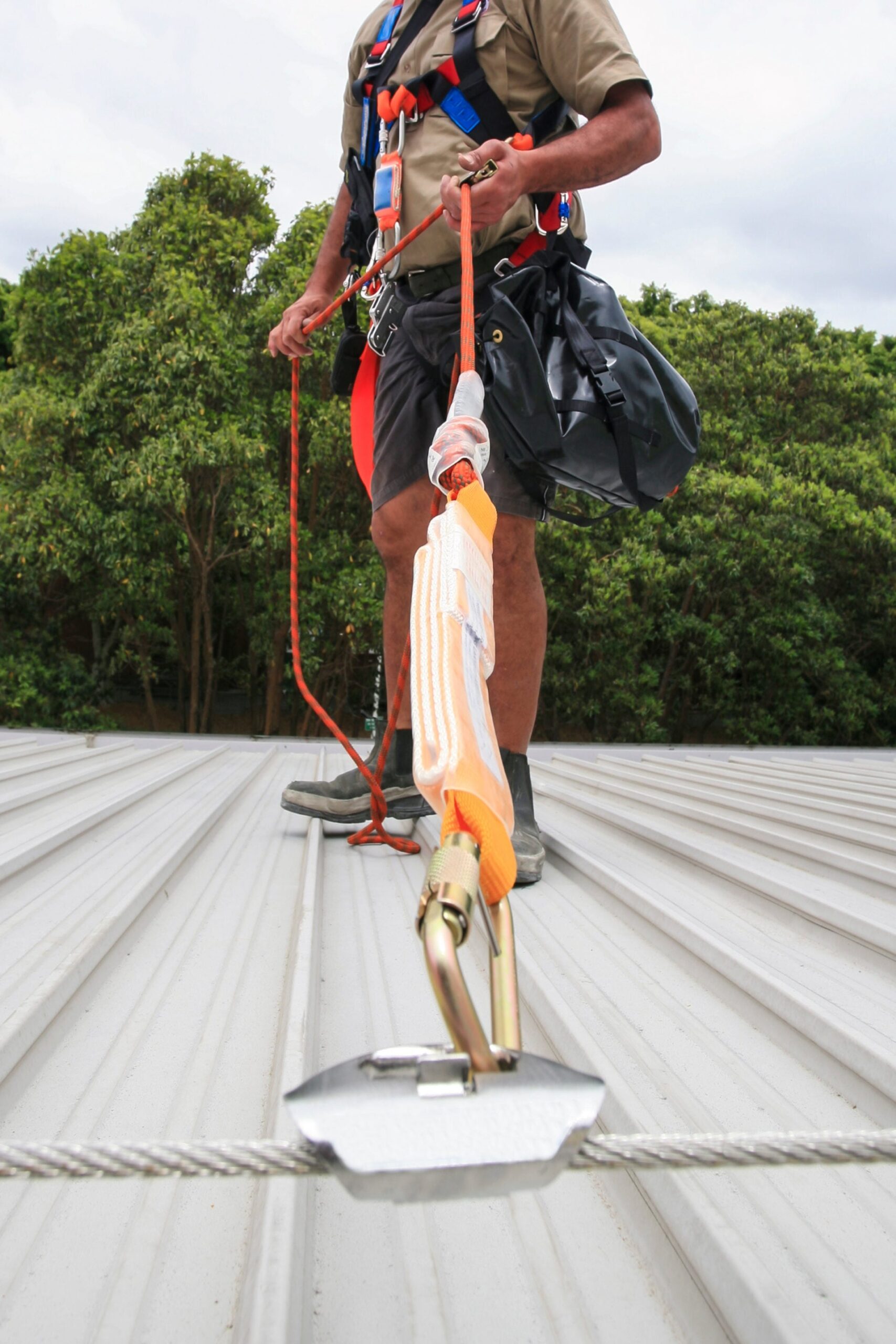
Clearance is influenced by several factors and does not always have the same configuration. Considering the standard scenario, we analyze a worker wearing a full body harness (EN 361) connected to a point anchor device (Type A) positioned at walking surface level.
The worker is connected by means of a 2 m fall arrest lanyard (EN 354), selected to facilitate work activities, and an energy absorber, i.e. a device that elongates during a fall through specific mechanisms, dissipating energy and reducing the forces transmitted to the worker’s body (EN 355).
In this case, the required clearance is 6.25 m, consisting of:
TOTAL: 2 + 1.75 + 1.5 + 1 = 6.25 m
If the worker is instead connected to a horizontal flexible lifeline Type C, the previously calculated value must be increased by the cable deflection (D) caused by the fall. This value is specified in the manufacturer’s manual and depends on the anchor spacing (S) and the lifeline length (L). Typically, deflection is in the order of 2.8 m.
As a result, a minimum unobstructed space of 9 m below the worker is required.
However, this value can be reduced through specific design measures, such as decreasing the distance between lifeline supports by adding intermediate anchors, thereby reducing cable deflection. Alternatively, the anchorage point can be positioned above the walking surface. This reduces the fall factor and shifts the required arrest distance upward.
Another option is the use of a rigid rail lifeline system, which has negligible deflection and behaves like a fixed anchor point. The advantage is that it allows the worker to travel long distances without disconnecting from the system, significantly improving ergonomics.
Finally, the standard 2 m lanyard can be replaced with a shorter one, reducing the free fall distance. This allows the use of an energy absorber requiring less arrest distance, thus reducing the total clearance. The combined length (lanyard + absorber) can be reduced from 3.75 m for standard configurations to 2.10 m when using 80 cm lanyards.
This also makes it possible to limit the worker’s movement, creating a restraint system, where the anchorage point is positioned at a distance from the edge at least equal to the lanyard length, preventing any possible fall.