The recent amendments to Legislative Decree 81/2008 have updated the regulatory framework concerning access to work at height and protection against falls from height. In particular, Articles 113 and 115 of Legislative Decree 81 have been revised with the aim of clarifying the criteria for the selection, use and design of ladders and fall protection systems, strengthening ladder safety regulations and enhancing risk control on construction sites and in workplaces.
For RSPP, HSE managers, consultants and companies, these updates affect the management of portable ladders, fixed ladders under Legislative Decree 81/2008 and, more generally, ladders for work at height and the related personal protective equipment.
To understand the meaning of the amendments, it is useful to briefly recall the previous approach of Legislative Decree 81/08 regarding ladders and work at height.
Article 113 regulated the use of different types of ladders, including portable ladders and extension/section ladders, as well as fixed ladders. With regard to ladder regulations for access to work at height, the provision specifically required protective measures for portable ladders:
installed vertically or with an inclination greater than 75°;
with a length (vertical rise) greater than 5 metres.
In many contexts, the most widespread measure was the metal safety cage, often considered sufficient to meet ladder safety requirements. Other aspects, such as the inclination of the ladder, the distance from the wall, or the possible integration with additional protection systems, were sometimes managed in a less structured way.
The previous Article 115 concerned the use of personal protective equipment against falls from height when collective protection measures could not be implemented. The text referred to harnesses, lanyards, energy absorbers, and flexible and rigid lifelines.
In operational practice, in many cases the standard response to work at height consisted of a harness and lanyard with an energy absorber, with less attention paid to the distinction between restraint, work positioning and fall arrest systems, and with a less evident link to risk assessment.
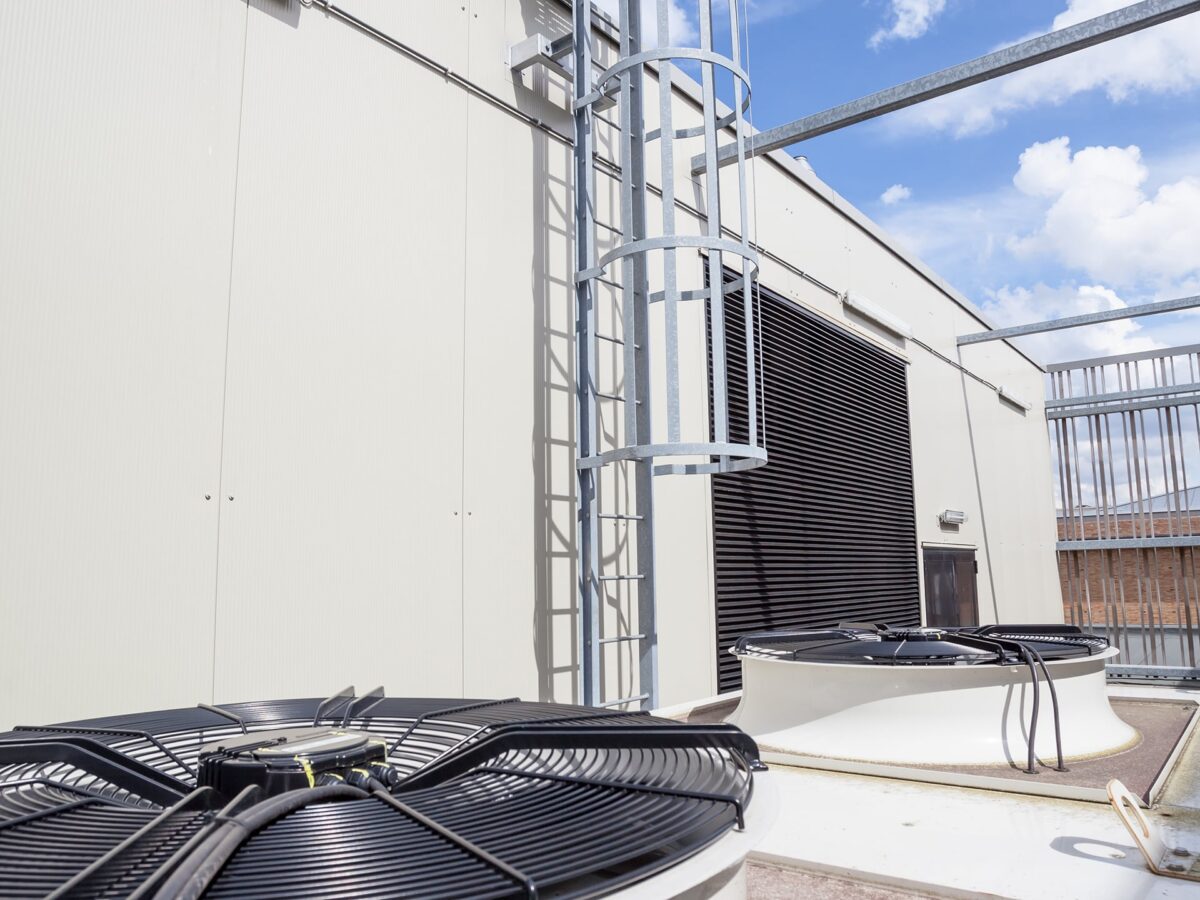
With the update of Legislative Decree 81/08, Article 113 has been reformulated with a specific focus on fixed vertical ladders used to access roofs, plants and structures. This category includes many “scale alla marinara” fixed ladders installed on civil and industrial buildings under Legislative Decree 81/08.
A first update concerns the scope of the ladder regulations. Protection is no longer limited to ladders with a vertical rise of more than 5 metres, but is extended to fixed ladders, namely:
permanent vertical ladders with a height above a given threshold (2 metres as the minimum threshold).
The regulation still applies to ladders with an inclination greater than 75° used as access to work at height. In this way, ladder safety legislation more clearly includes service ladders and access points that could previously have been considered marginal.
A second update concerns the type of protection. For these fixed vertical ladders, Article 113 provides two main solutions:
The choice is no longer automatic. The decision between a cage and a fall protection system must be based on the risk assessment: frequency of use, access route, evacuation and rescue procedures, and obstacles along the climb.
The update of Article 113 does not introduce new geometric parameters, but confirms requirements already included in the previous wording for fixed vertical ladders. In particular, references remain to:
These provisions are recalled because they remain consistent with the approach of the relevant technical standards (industrial ladders/fixed ladders) and help maintain design continuity and verifiability of the solutions adopted for plants and permanent access systems.
The new Article 115 of Legislative Decree 81 (sometimes incorrectly referred to as “Decree 115 of 2008”) reorganises the criteria for the use of fall protection systems for work at height.
Compared to the previous version, the text no longer merely lists PPE, but introduces a clear hierarchy. The new Article 115 confirms that:
Within PPE, Article 115 distinguishes between:
This approach promotes the adoption of solutions that limit exposure to risk, reserving fall arrest systems for situations in which other options are not practicable. For prevention professionals, this implies a more rigorous justification of the choices made in relation to the different work-at-height scenarios.
The amendments to Articles 113 and 115 of Legislative Decree 81/08 translate into operational activities involving employers, RSPP, coordinators and consultants.
A first step is to map the ladders used for work at height available within the company, with particular attention to:
For each ladder, it is useful to check height, ladder inclination (portable or fixed), presence of cages, installed fall protection systems, frequency of use and environmental conditions.
For fixed vertical ladders, compliance with ladder safety regulations and the provisions of Legislative Decree 81/08 must be verified, in particular with regard to:
With regard to PPE, Article 115 requires a hierarchical assessment of available solutions. In summary:
This approach entails, for example, designing anchor points set back from the edge and using lifeline systems intended for restraint, reducing the possibility that the operator can reach the fall hazard zone.
The regulatory updates make it advisable to update training and company procedures, with particular reference to: