Working at height comes with inherent risks, making robust fall protection non-negotiable. For professionals and decision-makers in construction, industrial maintenance, logistics, and more, understanding and implementing effective horizontal lifeline systems is paramount. This comprehensive guide will demystify these crucial safety solutions, helping you navigate the complexities of selection, installation, compliance with safety regulations, and ongoing maintenance to ensure the highest level of worker safety.
At Spider, we specialise in providing cutting-edge horizontal fall protection systems designed to meet the rigorous demands of various work environments. Our range includes versatile solutions tailored for both permanent and temporary applications, ensuring your team is safe and compliant.
Table of contents:
CONTACT US
What is a horizontal lifeline system?
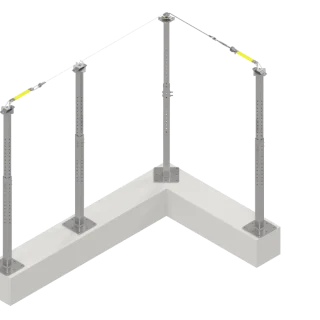
A horizontal lifeline system is a critical component of a personal fall arrest system, designed to protect workers operating at height along a horizontal plane. A horizontal safety line system allows a worker to move along an extended length, connected by a lanyard and harness, while remaining continuously protected from falls.
These systems are engineered to absorb the energy generated during a fall, minimising the impact force on the worker and preventing them from reaching the ground or a lower level.
For a comprehensive overview of all our fall protection solutions, including vertical and temporary systems, please visit our main lifeline systems page:
Exploring types of horizontal lifeline systems
Horizontal fall protection systems come in various configurations, each suited to different environments and operational needs:
Produits connexes
Horizontal lifeline systems: your complete guide to superior fall protection
PSIE0001
Poteau Siena H=350 inox. Le dispositif est un poteau qui peut être ut…
LINEA VITA SX-GREEN
Ligne de vie Smart Cross Green – SX-GREEN Système anti-chute permanen…
LV3ANR2X
Renvoi d’angle inox Le dispositif est utilisé comme renvoi d’angle po…
LV3PADX
Plaque double d’ancrage inox Le dispositif permet l’installation de p…
LEPROL200
Rallonge H 200 galvanisée Le dispositif est utilisé comme rallonge po…
LEPROL150
Rallonge H 150 galvanisée Le dispositif est utilisé comme rallonge po…
LE3PLM1800I
Poteau Multy H=1800 galvanisé Le dispositif est un poteau qui peut êt…
LE3PLM1300I
Poteau Multy H=1300 galvanisé Le dispositif est un poteau qui peut êt…
LE3PLM6001000I
Poteau Multy H=600-1000 galvanisé Le dispositif est un poteau qui peu…
LINEA VITA MULTY
Ligne de vie MULTY – Système anti-chute permanent pour toitures résid…
PSLX0005
POTEAU SILEX – STRUCTURE SEULE Le dispositif est utilisé pour constit…
Get in touch with our fall protection experts
CONTACT US
Where safety meets efficiency: key applications
Horizontal lifeline systems aren’t just a safety requirement; they are the backbone of operational continuity in high-risk environments. From soaring construction sites to complex industrial floors, these systems provide the freedom to move and the security to focus on the task at hand.
Explore how these solutions adapt to your specific industry:
Construction & infrastructure
- The Challenge: Navigating skeletal structures and unprotected roof edges.
- The Solution: Provides seamless, continuous protection for workers during building and renovation projects, ensuring safe access even before permanent guardrails are in place.
Industrial maintenance
- The Challenge: Servicing hard-to-reach machinery, conveyors, and silos.
- The Solution: Lifelines allow technicians to traverse elevated manufacturing equipment safely, reducing downtime by making routine maintenance faster and more secure.
Logistics & warehousing
- The Challenge: Working on high-bay racking systems and open loading docks.
- The Solution: Protects staff during inventory management and loading operations, where a single slip could be catastrophic without a reliable arrest system.
Utilities & telecommunications
- The Challenge: Maintaining power lines and communication towers at extreme heights.
- The Solution: Specialized horizontal systems ensure that technicians remain tethered while transitioning between vertical climbs and horizontal platforms.
Building & facade management
- The Challenge: Routine HVAC servicing, window cleaning, and gutter maintenance.
- The Solution: Offers a discreet yet robust safety anchor for facility managers, ensuring that facade inspections and roof-top repairs are always compliant with safety standards.
Extreme rigorous certifications and standards for those who put their life on the line
Adherence to safety regulations and standards is not just a legal requirement—it is a fundamental commitment to every person working at height. When the stakes involve human life, there is no room for compromise. Every component of our horizontal lifeline system is engineered to exceed safety benchmarks, ensuring that those operating in high-risk zones have the most reliable fall protection available.
Our safety framework follows a strict professional hierarchy:
General safety principles: the foundation of trust
Safety regulations place a clear duty on employers and site managers to plan, supervise, and execute work at height with zero compromises. This is achieved through a disciplined Hierarchy of Control:
- Risk assessment: A meticulous, professional identification of every potential hazard before a horizontal safety line is even deployed.
- Hierarchy of control: We prioritize collective prevention whenever possible, utilizing our advanced horizontal fall arrest systems as the ultimate, fail-safe mitigation strategy.
- Competent persons: Expertise is the best safety device. From initial design to the final bolt, we ensure that every lifeline installation and inspection is performed by certified industry experts.
International standards: global benchmarks for local safety
Our equipment is not just durable—it is scientifically validated against the most demanding international safety benchmarks:
- EN 795 (The Gold Standard): All our anchor devices are fully compliant with these rigorous requirements. We offer Type C solutions for flexible cable-based lifeline systems and Type D for rigid, high-performance safety rails.
- ISO & Global Compliance: We go beyond the minimum. Our technical standards provide actionable, practical guidance on the selection, use, and maintenance of fall protection systems.
- Mandatory Certification: We emphasize and manage regular recertification, ensuring that your horizontal life line remains as reliable in year five as it was on day one.
Understanding horizontal lifeline installation
Installation demands meticulous planning and technical expertise. It is not a task for the untrained.
- Site assessment: Identifying hazards and structural capabilities.
- Structural integrity check: Ensuring attachment points can withstand static and dynamic loads.
- Component selection: Using high-quality cables, tensioners, and shock absorbers conforming to relevant standards.
- Professional installation: Secure attachment and tensioning by certified technicians.
- Testing and certification: Post-installation verification and issuance of a certificate of conformity.
Horizontal lifeline anchor points: selection and importance
The effectiveness of the system hinges on the strength of its anchor points.
| Type |
Description |
| Fixed |
Permanent anchors installed into steel, concrete, or timber. |
| Mobile |
Temporary anchors like beam clamps or deadweight anchors. |
| Structural |
Integrated directly into the primary load-bearing elements. |
Maintenance and inspection: ensuring ongoing safety
| Activity |
Frequency |
| User checks |
Before each use (visual inspection) |
| Competent person inspection |
Every 6 to 12 months |
| Annual certification |
Mandatory every 12 months by a certified technician |
| Documentation |
Continuous (logs of inspections and repairs) |
Why choose our horizontal lifeline solutions?
Invest in a partner who prioritises safety, compliance, and long-term reliability:
-
- Regulatory expertise: Deep knowledge of current work at height regulations and relevant standards.
- Reliable performance: Tested and trusted. Spider has been rigorously tested on built roofs and endorsed by 3rd-party safety validation.
- Easy integration: Our lifelines have been engineered for multiple roof types and can be designed to accommodate varying building shapes.
- Cost-effective: The Spider horizontal life line system is a flexible, cost effective option for working at height.
- Bespoke design: We don’t believe in one-size-fits-all. Our engineering team provides custom-tailored systems specifically designed for your unique structural environment, ensuring optimal safety while respecting the architectural integrity of your building.
- Certified by professionals: Safety is only as good as its installation. Our systems are fitted and verified by highly trained, certified installers and inspectors who ensure every component meets the most stringent international safety requirements.
- Comprehensive service: We partner with you through the entire lifecycle of your safety system, from the initial site assessment and bespoke design to professional installation, mandated annual inspections, and official recertification.
Get connected to our fall protection experts
CONTACT US
Frequently Asked Questions (FAQ)
To provide continuous fall protection along a horizontal plane, allowing movement while arresting a fall and minimising injury.
Yes, where work at height cannot be avoided and other measures (like guardrails) are not practicable, personal fall arrest systems become mandatory to mitigate fall risks.
Visually by the user before every use, and formally by a competent person at least every 6 to 12 months.
No. Formally trained and certified professionals must carry out installation to ensure structural integrity and safety.